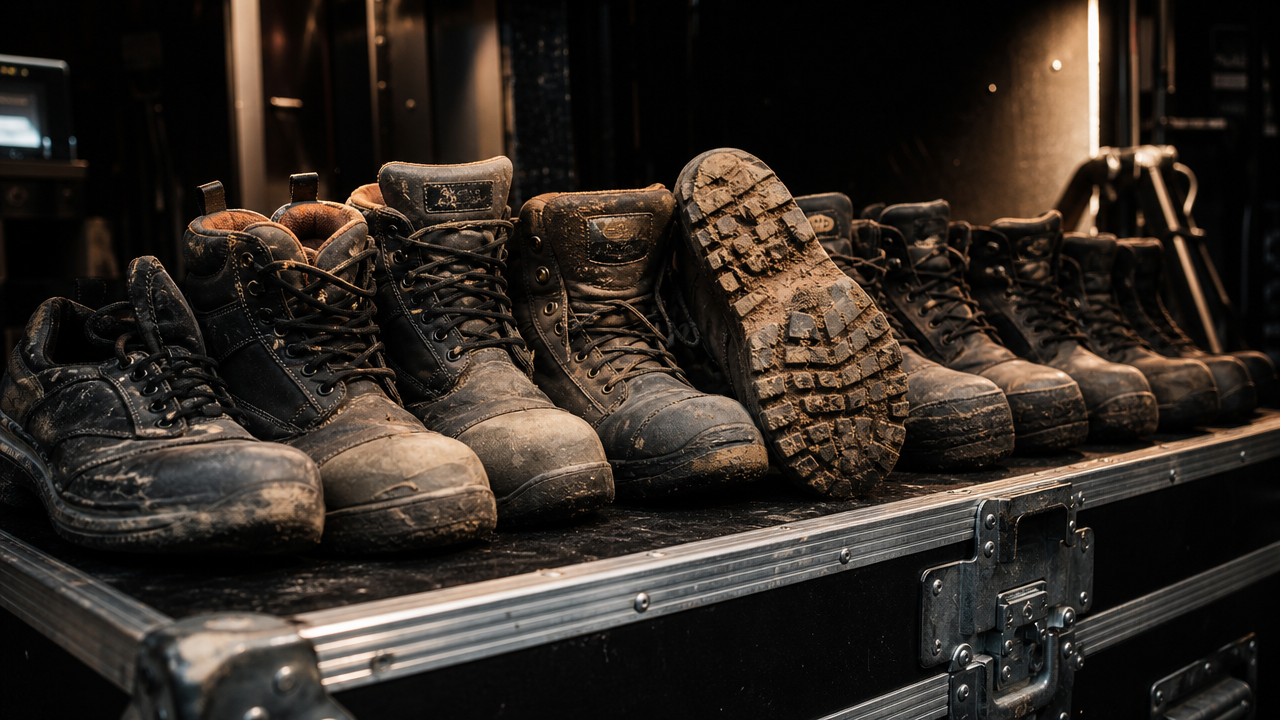
But which shoes do you buy then? What does all that letter soup on the label mean? And why does one S3 feel like a slipper and another like a concrete block?
This guide lines it all up. Written by people who take thousands of steps in them every week themselves.
A bit of history first
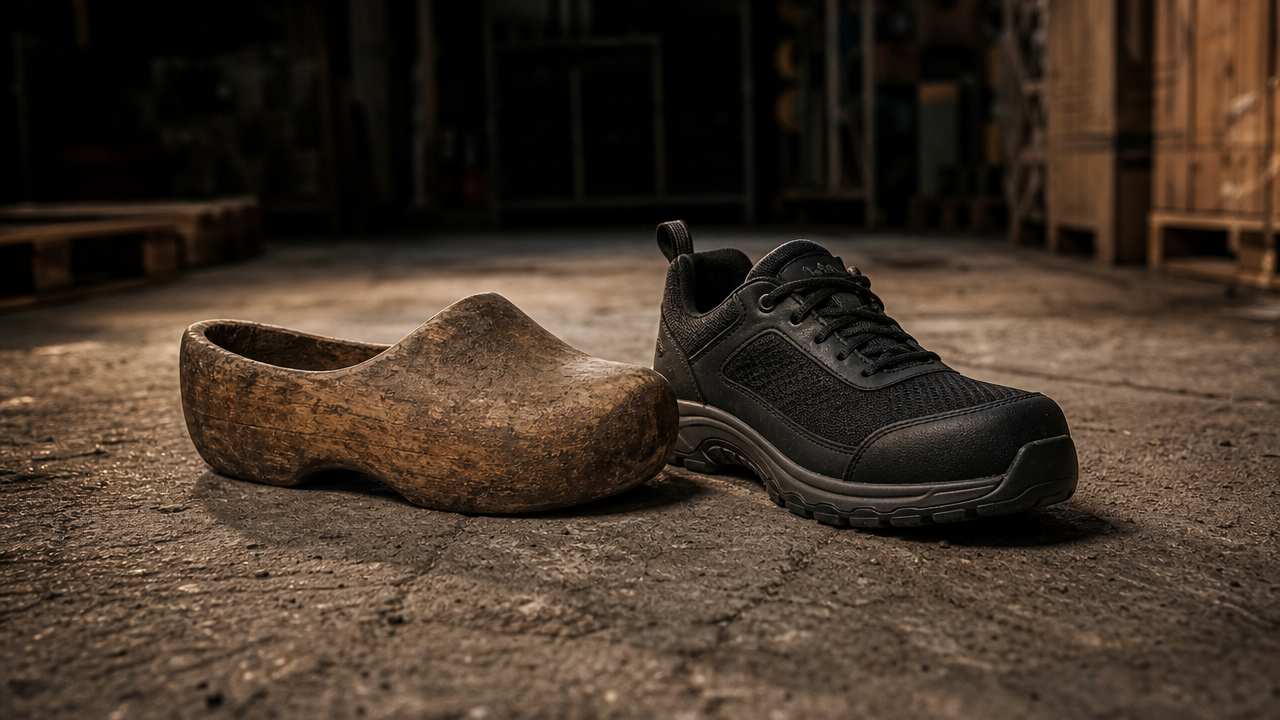
The safety shoe started life as a clog. Wooden footwear protected the feet of farmers, dockworkers and factory hands for centuries: cheap, sturdy and surprisingly effective against falling loads.
A persistent story exists about that clog: the word “sabotage” is said to come from workers throwing their sabots (clogs) into machines in protest. Great story, but linguists disagree and the evidence is thin. More likely “saboter” simply meant “working clumsily, botching the job”, like someone walking on clogs. We still think it is a beautiful story.
The steel toecap appeared in the early twentieth century, when the industrial safety movement got going and employers discovered that a crushed foot was more expensive than a good shoe. After the Second World War the safety shoe gradually became the norm in Europe and the US, and from the 1990s European standards arrived that have since grown into the EN ISO 20345 found on every label.
And the clog itself, the grand dame of the safety shoe? It still exists as a certified safety clog with S3 approval. From farmyard to standard, in a hundred years.
The standards: what does all that letter soup mean?
All safety shoes in Europe fall under EN ISO 20345. The core of that standard: a protective toecap that withstands an impact of 200 joules. In concrete terms: a weight of 20 kilos dropped onto your toes from a metre high. A flight case sliding off the tail lift, so to speak.
Note: since 2022 there is a new version of the standard (EN ISO 20345:2022). Shoes made to the old 2011 standard may still be sold for a while, so you will find both labels in the shop. Both are safe, but the codes differ slightly.
The main classes
| Class | What you get | For whom |
|---|---|---|
| SB | Only the basic protection: 200J toecap | Minimum, rarely sufficient on a site |
| S1 | SB + closed heel, antistatic, energy absorption in the heel | Dry indoor environments |
| S1P | S1 + penetration-resistant midsole | Indoor work with nails, screws, sharp waste |
| S2 | S1 + water-repellent upper | Damp environments |
| S3 | S2 + penetration-resistant midsole + profiled sole | The all-rounder. Most worn class, including with us |
| S4 / S5 | Fully rubber or polymer boots (S5 with penetration-resistant midsole) | Mud, a festival meadow after three days of rain |
| S6 | S2, but the whole shoe is waterproof | Wet outdoor work |
| S7 | S3, but the whole shoe is waterproof | Wet outdoor work with penetration risk. The festival-build king |
S3, S3L or S3S: the new distinction
Since the 2022 standard the code also says something about the penetration-resistant midsole:
- S3: metal midsole (steel)
- S3L: non-metal (textile) midsole, tested with a thick 4.5 mm nail
- S3S: non-metal midsole, tested with a thin 3 mm nail (the stricter test, because thinner punctures more easily)
Non-metal soles are lighter, more flexible and insulate better against cold. Metal soles are indestructible but heavier. The same distinction exists for S1P (S1PL, S1PS), S5 and S7.
The extra letters
| Code | Meaning |
|---|---|
| SR | Slip resistance (new test since 2022; replaces the old SRA/SRB/SRC) |
| FO | Sole resistant to oil and fuels (used to be standard, now a separate marking) |
| HRO | Sole resistant to contact heat up to 300 °C |
| HI / CI | Insulation against heat / cold |
| WR | Fully waterproof shoe |
| WPA | Water-repellent upper (the old WRU) |
| ESD | Discharges static electricity in a controlled way (important for electronics and AV gear) |
| M | Metatarsal protection |
| AN | Ankle protection |
| CR | Cut-resistant upper |
| SC | Abrasion-resistant scuff cap, new since 2022 |
| LG | Extra grip on ladder rungs, new since 2022 |
Above all, remember this: for event work S3 is the starting point. If you work outside in the rain a lot, look at S7. If you want light and metal-free, look for S3L or S3S.
High or low: what is more ergonomic?
The eternal debate in the crew cabin. The honest answer: it depends on your site and your ankles.
High shoes (above the ankle):
- More support on uneven terrain: festival meadows, cable ducts, scaffold floors
- Protect the ankle against bumps from carts and cases
- Warmer, heavier, and less ankle freedom of movement
Low shoes:
- Lighter and cooler, less tiring during long shifts on flat floors (arenas, expo halls)
- Freer ankle movement when crouching, kneeling, climbing stairs
- No ankle support on rough terrain
Our rule of thumb: flat venue, low shoe. Meadow or terrain work, high shoe or a mid model as a compromise. Anyone with weak ankles (once sprained, stays sensitive): choose high, always.
And on ergonomics, this too: the best shoe is the shoe that fits. Try shoes on at the end of the day, when your feet are slightly swollen, exactly as after eight hours of load-in. Bring the socks you wear on site. And break in new shoes at home before doing a festival weekend in them.
Light, lighter, lightest
Every 100 grams on your foot gets lifted thousands of times per shift. Heavy footwear is slow fatigue. What to look at to buy light:
- The toecap. Composite or plastic toecaps are significantly lighter than steel, conduct no cold and are fully metal-free. Aluminium sits in between. All three pass the same 200 joules; the difference is weight and volume (composite is slightly bulkier).
- The midsole. Choose S3L or S3S (textile penetration resistance) instead of classic steel.
- The upper. Microfibre and technical textiles are lighter than full-grain leather, dry faster and are often washable. Leather stays more abrasion-resistant in rough work.
- The sole. PU/PU and PU/TPU soles are supple and light; rubber is heavier but more heat-resistant (HRO).
- The number. Manufacturers list the weight per shoe in size 42. Under 550 grams is light, around 450 grams is sneaker territory, above 700 grams you feel it at 4 in the morning.
Modern “safety sneakers” combine all of that and are barely distinguishable from sports shoes. For arena and expo work they are worth their weight in gold. For heavy terrain work a sturdier shoe remains the better choice.
Sustainable and animal-free
Safety shoes are classically a disposable product: used intensively, worn out after a year or eighteen months, and then into the incinerator. It can be different.
Circular. Dutch manufacturer EMMA (since 1931) was the first in the world to make a fully circular safety shoe: every shoe has a material passport, worn-out pairs are collected for free and the raw materials are reused in things like insulation material and furniture. They produce in-house, on solar energy, and per pair a quarter of an hour of production is done by someone at a distance from the labour market. Safety first, then comfort, then circularity: that is the order we apply too.
Animal-free. Anyone who wants no leather (like the undersigned) is better off today than ever. Microfibre and technical textiles no longer underperform leather, and more and more models are completely free of animal materials. Mind you: “leather-free” is not automatically “vegan”, because glues can contain animal ingredients too. A few brands have their models explicitly vegan-certified; ask for it or check the product sheet.
Repair and extend. Worn insoles can be replaced separately (do so, at least every six months with intensive use). Laces too. And a shoe you let dry after every wet site (not on the radiator!) lasts months longer.
What do we wear at Hands 4 Events?
Our guideline for crew, short and sweet:
- Minimum S3 (or S3L/S3S). Penetration resistance is no luxury on a site full of stage parts, screws and truss pins.
- Low or mid for arena work, high for terrain work. Choose according to your most common site.
- Metal-free recommended. Lighter, no cold toes in winter, and you do not beep at every detection gate.
- Weight under 600 grams per shoe as a guideline. Your feet thank you at 3 in the morning.
- Replace in time. A toecap that has taken a real hit is used up, even if you see nothing. On average an intensively worn pair lasts 12 to 18 months.
- Your own shoes, well maintained. Dry after every wet shift, replace insoles regularly and keep a spare pair ready in busy periods.
Where do you buy them? (Belgium and the Netherlands)
Trying on in person is something we always recommend for your first pair. Reordering online afterwards is no problem.
- Van Hoof Veiligheid (Brecht and Aartselaar): specialist shop in the Antwerp region with stores and a webshop. Ideal for trying on.
- Vandeputte Safety Experts (vdp.com, headquarters in the Antwerp region): brand-independent safety specialist with a very wide range (EMMA, Elten, Uvex, Diadora, Cofra, Bata and more), including a separate selection of sustainable safety shoes.
- Artelli (Kontich): Belgian distributor of safety shoes and PPE, 20+ years.
- Werkkledij Center (Wortegem-Petegem): shop plus webshop.
- EMMA Safety Footwear (emmasafetyfootwear.shop): straight from the circular pioneer.
- Werkschoenen.shop: large NL/BE webshop with a broad budget-to-premium range.
- Larger hardware and trade suppliers such as Würth also have a solid shoe range and good standards advice.
Tip: when in doubt, order two sizes and send one back. Half a size of difference is, at hour eight of a shift, the difference between pushing on and suffering.