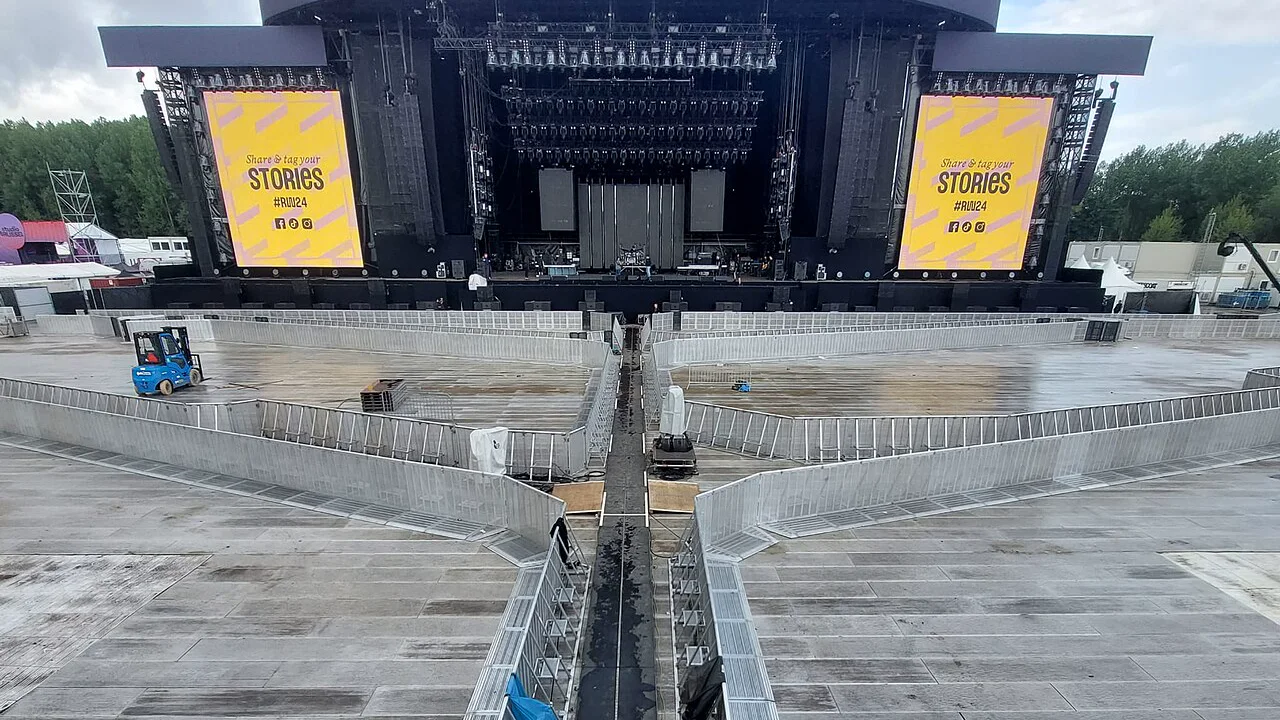
Why the fence at the front is called "the mojo".
I already promised it in the blog post about the nadar fence: front of stage barriers deserve a separate post. So here it is. That heavy fence between the audience and the stage, which everyone in the industry simply calls "the mojo", has a story of its own. And it is one that has literally saved lives.
This is part five in the series about everyday crew equipment with a remarkable story: after the nadar, the cable tie, the gaffer tape and the stagehand itself.
Late 1980s: improvising in front of the stage
It is hard to imagine today, but until well into the 1980s there simply was no proper fence for the front of a stage. Organisers used whatever was available: police barriers, flight cases, scaffolding with wooden boards tied to it. The biggest artists in the world literally had makeshift constructions in front of them.
The result is easy to guess. At concerts, people became trapped and were injured against that improvised equipment. It reached a point where some artists refused to play large shows until a real solution arrived.
1988: the Netherlands solves it
That solution came from the Netherlands. Concert promoter Mojo Concerts (the people behind almost every major show in the Low Countries) decided in 1988 to develop a proper stage barrier themselves, initially just for their own use. That is how Mojo Barriers began: the first company in the world with a purpose-built stage barrier.
It caught on immediately. Production teams for artists such as Prince, U2, the Rolling Stones and Metallica were soon knocking on the door. The first versions were made of steel; later came the aluminium system, about forty percent lighter and now the global standard.
And so Mojo experienced what had happened to Nadar before it: the brand name became the generic name. Just as every vacuum cleaner became a Hoover in Britain and every crowd control fence became a nadar in Belgium, every front of stage barrier is now called "a mojo". Even when it comes from another brand. This is part five of the series, and it is already the fourth time a name has stuck. Apparently that is how our industry works.
The clever trick: the audience keeps the barrier upright
This is where it gets elegant. How do you keep a fence upright when thousands of people are pushing against it? You cannot bolt it into a festival field. Weighing it down with concrete would be unaffordable and impossible to move.
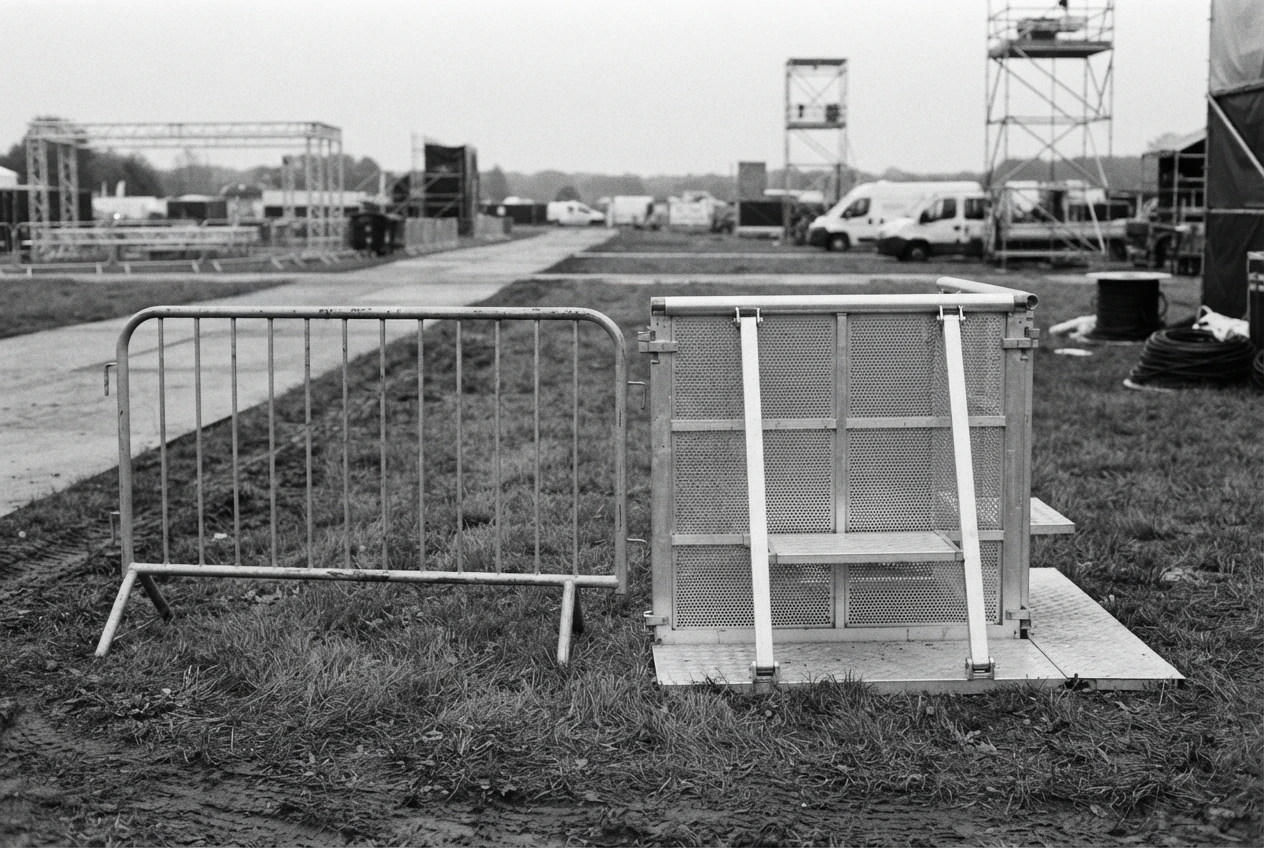
The answer is in its shape. A mojo has a vertical panel facing the audience, and a floor plate that extends forwards beneath the feet of the first rows. The result: the harder the crowd pushes forwards, the more that same crowd presses down on the floor plate with its own weight and forces the barrier towards the ground.
The audience itself keeps the barrier that protects it upright. The pushing force is used against itself. That is not brute force, it is judo in aluminium. And it is exactly why a mojo never stands loose on feet like a nadar: without people on the plate, the system does not work as intended.
At the back there is a step for security in the pit, and the sections connect to form one continuous line. Special corners, doors and cable ramps turn it into a complete system. Everything is tested and certified; this is no longer just a fence, this is engineering.
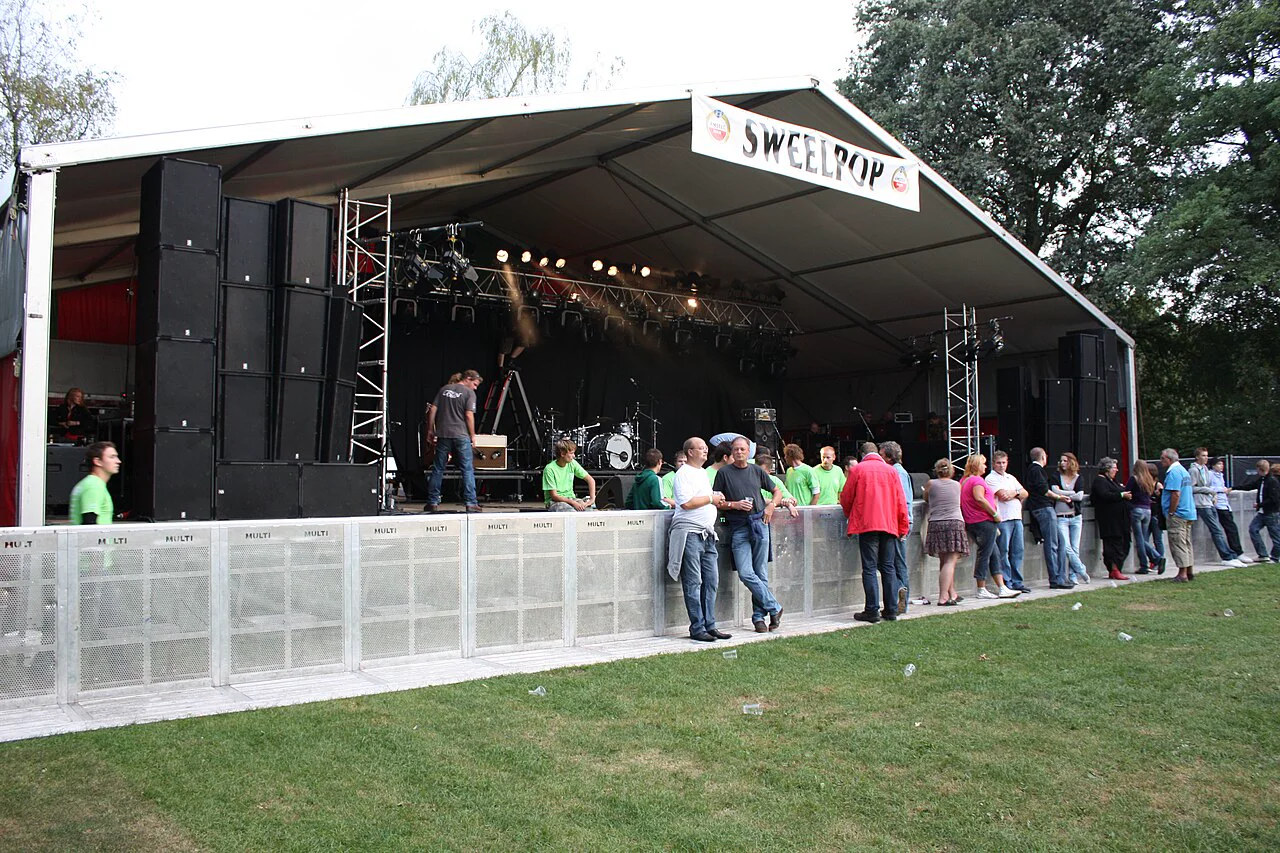
Photo credits: Goran Marincic under CC BY-SA 4.0, and Hugovanmeijeren under CC BY-SA 3.0. The first photo was cropped and both photos were converted to a web format.
Why the pit is more than a fence
A mojo on its own does not make a show safe. The barrier creates the pit: the narrow corridor between the audience and the stage where security works. From there they catch crowd surfers, hand water to the first rows and monitor the pressure.
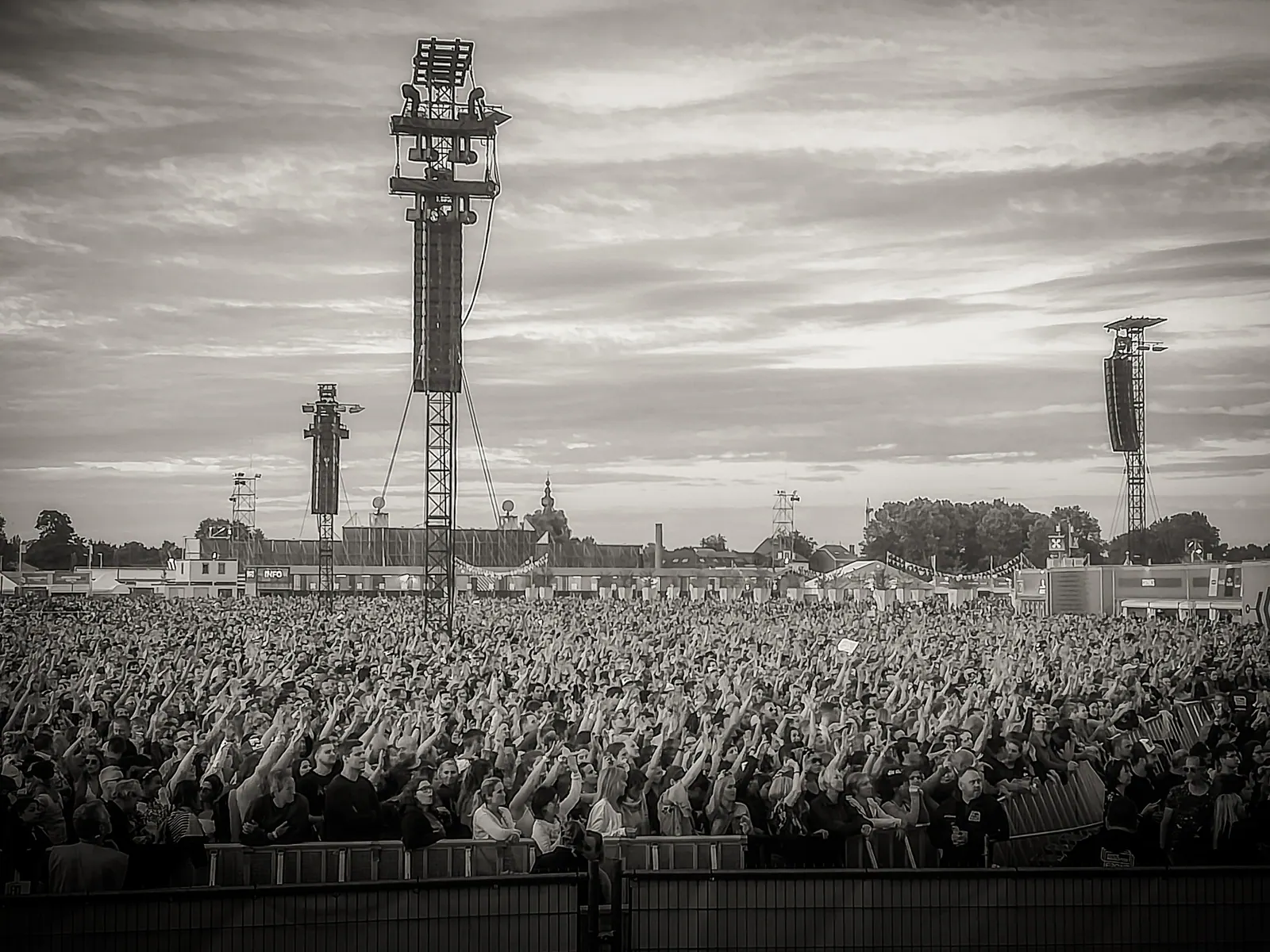
At very large shows, you will see more than one line. Additional barrier lines divide the audience into sections so that the pressure of 60,000 people never reaches the front row all at once. That approach did not appear by accident. The industry learned from serious incidents, such as the tragedy at Roskilde in 2000, where nine people died in the crush. Since then, crowd management has become a discipline in its own right, with barrier plans prepared months before a festival.
Every fence on that drawing is there for a reason. Anyone who has built a pit knows that placement must be exact, every connection must be right, and everything gets checked twice. Nothing will hang above that barrier, but half a city will lean against it.
What is a mojo called abroad?
Belgium & the Netherlands
- Mojo, mojo barrier or mojohek. More formally: podium barrier or stage barrier.
English-speaking world
- Stage barrier, crowd barrier or crash barrier. In the US, bike rack is also used for the lighter types, while a true front of stage barrier is often simply called a barricade.
Germany
- Bühnengitter, or Wellenbrecher for the extra lines within the audience. Wellenbrecher literally means breakwater. It could not be more fitting: the crowd moves like water, and the barriers break the waves.
France
- Barrière de scène or barrière anti-panique.
A few interesting facts
- Breakwaters are not just a metaphor. The same construction logic as the front of stage barrier is also used for mobile flood defences. The problem is identical: stopping a large pressing mass without anchoring anything into the ground.
- From festival field to world stage. Mojo barriers have appeared not only at Glastonbury and on AC/DC world tours, but also at G20 summits. Same fence, different crowd.
- The pit as the best place at the festival. Ask any fan who has ever stood at the front: the magic is greatest just behind that fence. Few people realise they owe that spot to a piece of Dutch ingenuity from 1988.
- Nadars and mojos are not competitors. You will find both at one festival, each with its own job: the nadar marks boundaries and guides flows, while the mojo absorbs pressure. Putting a nadar in front of a main stage is not a saving, it is a risk.
Next time you stand at the front with your feet on that aluminium plate, remember: you are standing on the fence that protects you. And it only works because you are standing on it. Engineering does not get more elegant than that.